Introduction: River transport
Electric current, measured in amperes (A), is the constant flow of charge through a conductor. This physical phenomenon, the basis of all electrical and electronic devices, occurs when electrons flow through a conductor. In this article, we take a detailed look at electric current, including its properties, types, and applications.
Scientific definition of electric current
Current is the rate at which charge flows through a conductor per unit time. Mathematically, the average current is calculated using the following formula:
I = ΔQ/Δt
Where:
-
I : Current (amperes)
-
ΔQ : change in charge (Coulomb)
-
Δt : time interval (in seconds)
Natural flow direction:
In electricity, the direction of electric current runs from positive to negative (opposite the actual direction of movement of the electrons).
History and units of flow measurement
André Marie Ampère (1775–1836):
-
The father of modern electrodynamics
-
The founder of quantitative electricity research
-
The unit of measurement ampere is named after him.
The modern definition of ampere is:
The ampere corresponds to a direct current which, if conducted through two infinitely long, parallel conductors one meter apart in a vacuum, would produce a force of 2×10⁻⁷ Newton per meter between them.
Current type
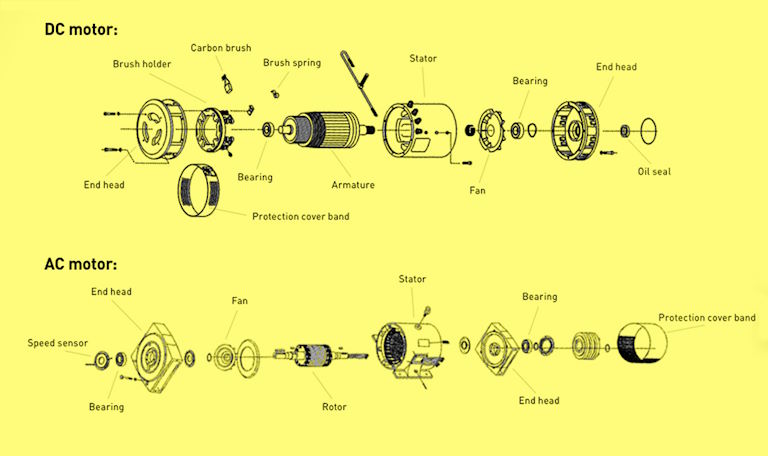
1. Direct current (DC):
-
Trend and constant value
-
Power source: battery, solar panel, AC-DC adapter
-
Application: Electronic devices, communication systems.
2. Alternating current (AC):
-
Magnitude and direction of change over time (usually sinusoidal)
-
Standard frequency: 50 or 60 Hz
-
Advantages: more convenient transport and less loss.
-
Application: urban power grids, industrial motors.
3. Pulse current:
-
Sudden changes between different values
-
Areas of application: digital systems, communication, engine control.
4. Special procedures:
-
High current (hundreds to thousands of amperes): arc furnaces
-
Low current (mA): Electronic circuits
-
Ultra-low current (microamperes): medical devices
Current generation methods
1. Electrochemical method:
-
Dry elements and wet elements
-
Fuel cells
-
primary battery
2. Electromagnetic method:
-
generator
-
Car generator
3. Photoelectric method:
-
solar cells
-
LEDs
4. Thermoelectric method:
-
Thermoelectric effect (conversion of heat into electrical current)
-
Thermos mug
5. Piezoelectric method:
-
Conversion of mechanical pressure into electrical current
Current measurement
Measuring tools:
-
Analog ammeter :
-
With hands and dial
-
Average accuracy
-
Fast response to changes
-
-
Digital multimeter (DMM) :
-
digital screen
-
High resolution
-
Multiparameter measurement capability
-
-
Ammeter :
-
Measurements can be carried out without interrupting the circuit.
-
Suitable for high currents
-
Safer
-
-
Current translation :
-
Indirect measurement by voltage drop
-
Suitable for very high currents.
-
Safety tips when measuring:
-
Ammeter in series with circuit breaker
-
Choose the right domain
-
Be careful in strong currents.
-
Use insulating equipment
 Ohm’s law and the relationship between current and other parameters
Ohm’s law:
I = P/P
Where:
-
I: Current (amperes)
-
V: Voltage (V)
-
R: Resistance (Ohm)
Force triangle:
-
The relationship between current and power (P = V × I)
-
The relationship between current and power (E=V×I×t)
-
The relationship between current and current density (J=I/A)
Current in an electrical system
General flow rates:
-
Products : Generators for thousands of amperes
-
Transmission : Lines from hundreds to thousands of amperes
-
Power distribution : from dozens to hundreds of amperes in transformers
-
Household current : 1–40 amps in various circuits
Effects of strong currents:
-
Driver heating
-
A conductor with a larger cross-section is required.
-
large energy loss
Influence of current on device performance
Rated current:
-
Optimal value for device operation
-
This is usually indicated on the nameplate.
Consequences of insufficient flow:
-
Overcurrent :
-
high temperature
-
Insulation damage
-
Fire hazard
-
-
underground canal :
-
Low device performance
-
Possibility of blocking the system
-
Low efficiency
-
Overcurrent protection
Protective devices:
-
Backup :
-
If the current is too high, use a circuit breaker.
-
Disposable
-
-
Circuit breaker (MCB) :
-
Disable overcurrent protection
-
Reset function
-
-
Protection level :
-
Several errors were found
-
selective separation
-
-
Current limiter :
-
Automatic flow control
-
Active defense
-
Special applications for different currents
High current:
-
Electric welding
-
Metal casting system
Low current:
-
electronic circuits
-
Communication systems
-
medical devices
Controlled flow:
-
automation system
-
Laboratory equipment
-
Precision measuring instruments
Practical consumption calculations
Current distribution for parallel resistors :
Total I = I1 + I2 + I3 + ...
The current in series resistors is the same:
Total I = I1 = I2 = I3 = ...
Calculation of the short-circuit current:
Short-circuit current = V/Z
The future of current event technologies
Future development:
-
High-temperature superconductors :
-
Power transmission without resistance
-
Reduce energy losses
-
-
Power semiconductors :
-
Precise control of high currents
-
Improving efficiency
-
-
Intelligent traffic management system :
-
Optimal traffic distribution
-
Avoid overloading
-
-
New measurement technology :
-
Nanosensors
-
wireless surveillance system
-
Safety precautions when coming into contact with electricity
Risk level:
-
Less than 10 mA: Generally safe
-
10–50 mA: Risk of electric shock
-
More than 50 milliamperes: risk of cardiac arrest
Preventive measures:
-
Turn off the power supply before starting work.
-
Use of security tools
-
Use reliable devices to check the current.
-
Compliance with electrical safety regulations
Result: Lifeline of the electrical system
Electric current is one of the fundamental physical quantities in electrical engineering and plays a crucial role in the operation of all electrical and electronic systems . A thorough understanding of electric current and its properties is essential for the design, operation, troubleshooting, and repair of circuits and devices.
The development of new technologies for generating, controlling, and measuring electrical current is opening up new horizons for the electrical and electronics industry. With the advancement of conductive materials, protection systems, and energy transmission methods, we will see new, more efficient applications of this physical phenomenon in our lives.